One Bag, Zero Excuses: The Canon Kit That Fits Under an Airplane Seat
There's a specific kind of founder guilt that hits around 6 a.m. at an airport gate in Denver. You booked the conference, you're wearing the good blazer, and your camera bag — the one with three bodies and a lighting case — is sitting at home because it was too heavy to justify. So the trade show floor goes undocumented, the customer conversation goes unrecorded, and your content calendar quietly starves for another week.
The fix isn't more discipline. It's less gear.
The Seven-Pound Rule
Every piece of equipment you carry has to earn its weight in either revenue or time saved. That's the whole filter. A kit that exceeds roughly seven pounds — about the heft of a loaded 16-inch laptop bag — stops being something you bring and starts being something you plan around. And gear you plan around is gear you don't shoot with.
So here's the one-bag build that's become something of a quiet standard among solo operators we've talked to:
- One Canon body. The R6 Mark II or even an R8 covers 95% of founder content. Full-frame sensor, fast autofocus, and video specs that won't embarrass you in a client's inbox.
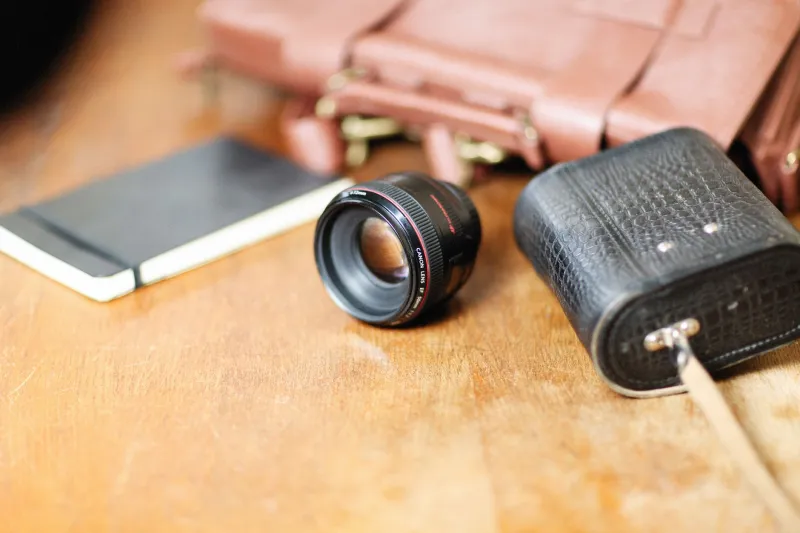
- Two prime lenses. A 35mm f/1.8 for environmental shots and b-roll, and an 85mm f/2 (or the 50mm f/1.8 if budget is tight) for interviews and portraits. Two focal lengths, zero zoom paralysis.
- One compact light. Something like a small on-camera LED panel that fits in a jacket pocket. Trade show lighting is a war crime; you need a way to fight back.
- A wireless lav or compact shotgun mic. Audio is where amateur content goes to die. A $200 mic setup does more for perceived production value than any lens upgrade.
- A sling bag, not a backpack. Slings swing to your front in two seconds. At a convention center, that speed is the difference between capturing the moment and explaining why you missed it.
Total damage: somewhere between $2,800 and $3,500 depending on how aggressive you get on the used market. Total weight: under seven pounds. Total excuses: zero.
Why Primes Beat Zooms When You're the Whole Crew
Zoom lenses feel practical until you're the one carrying them. A 24-70 f/2.8 is a phenomenal tool for a two-person crew and a terrible tool for a founder who's also running the booth, the demo, and the email follow-ups.
Primes force decisions before the shoot instead of during. You know the 35mm is for context and the 85mm is for faces, so when the Canon CEO of that SaaS company you've been courting walks past your booth, you're not hunting through a zoom range — you're already framed. Speed of reaction is the hidden spec that never shows up on a comparison chart.
There's also the honesty factor: primes are small enough that people forget you're shooting. Try getting natural founder-interview footage with a rig that looks like a Super Bowl sideline camera and see how relaxed your subject stays.
Three Real-World Scenarios, One Bag
The trade show floor. Booth lighting is fluorescent and hostile. Shoot wide open with the 35mm, bump your light panel to fill shadows on product demos, and let the R6 Mark II's autofocus track hands moving over hardware. Twenty minutes of shooting yields a week of LinkedIn content.
The founder interview. Coffee shop, conference room, hotel lobby — doesn't matter. 85mm, f/2, lav mic clipped to the collar, light panel bounced off a wall. This setup produces footage that reads as a $5,000 production, and nobody in the coffee line gives you a second look.
The product unboxing. This is where the compact kit quietly wins. Put the product near a window, use the 35mm handheld for the reveal, then lock off the 85mm for detail shots. The entire shoot happens in the fifteen minutes between meetings, which is the only fifteen minutes you actually have.
What We Deliberately Left Out
No tripod beyond a pocket-sized travel option. No drone. No second body — that's a previous conversation on this site, and for solo travel the answer is almost always no. No laptop-based editing on the road; a phone or tablet with a subscription editing app handles same-day social cuts fine.
Every one of those items is a weight tax that buys capability you'll use twice a year. The seven-pound kit buys capability you'll use every week.
Ship It From Anywhere
The whole point of LaunchFrame is that your content operation should travel as light as your ambition. A one-bag Canon kit means the next conference, client visit, or random Tuesday product shoot becomes footage instead of a missed opportunity. Pack it once, learn it cold, and stop leaving your marketing department at home because it didn't fit in overhead.