One Lens, Real Money: How to Map Canon Glass to Your Actual Revenue Before You Buy Anything Else
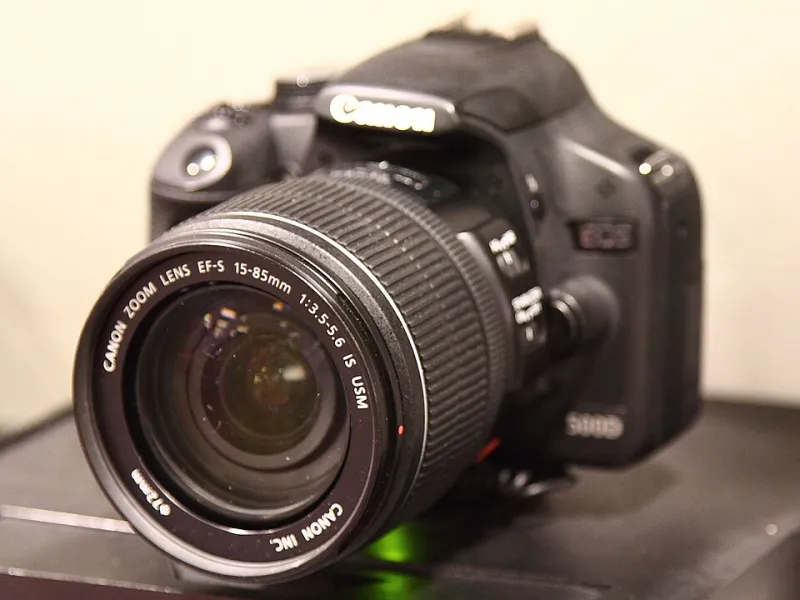
Photo: decltype, CC BY-SA 3.0, via Wikimedia Commons
Maria runs a brand photography business out of Austin. She launched eighteen months ago with a Canon EOS R8 and a single lens—the RF 50mm f/1.8. In her first year, she billed just over $34,000 in client work. She didn't buy a second lens until month nine.
That's not a gear flex. It's a business model.
The conversation around Canon lenses almost always defaults to optics: sharpness, bokeh, distortion, autofocus speed. Those things matter. But when you're standing at the start of a creative business with limited capital, the first question isn't "which lens is sharpest?" It's "which lens generates income fastest?"
Those are very different questions with very different answers.
The Myth of the Complete Kit
Gear culture has a gravity to it. Forums, YouTube channels, and Reddit threads create this ambient pressure to "complete your kit" before you start taking on clients. The logic sounds reasonable: be prepared for anything. In practice, it's a capital drain that delays your launch and trains you to spend money instead of make it.
A second or third lens purchased before you have recurring revenue isn't an investment—it's a liability with a lens cap.
The bootstrapped founder's framework should be simple: one lens earns before the next lens is purchased. That means your first lens choice carries enormous weight. Get it wrong and you're either pigeonholed into one type of work or fighting your gear on every job.
The One-Lens Year: What Actually Works
For most creative business categories—brand photography, headshots, content creation, product work, small event coverage—the Canon RF 50mm f/1.8 STM is the strongest single-lens business case in the entire Canon lineup. At under $200 new, it has the lowest barrier to entry of any RF prime. It shoots in low light. It produces the kind of creamy background separation that clients associate with "professional" photography. And it's wide enough to work in tight spaces while being long enough to stay flattering for portraits.
This isn't a compromise pick. It's a revenue-optimized pick.
If your work skews more toward interiors, real estate, or environmental brand storytelling—situations where you need to show context and space—the RF 16mm f/2.8 STM is worth considering as your anchor lens instead. It's similarly priced, and for architectural or hospitality clients, it covers ground the 50mm physically can't.
For video-forward founders creating content for brands or social media, the RF-S 18-45mm kit zoom actually holds up surprisingly well for its price point. It's not glamorous, but it covers a practical range that lets you move between talking-head setups and b-roll without swapping glass.
The key isn't which of these is "best." The key is choosing one and staying committed to it long enough to generate the revenue that justifies the next purchase.
When the Second Lens Makes Financial Sense
Here's a concrete trigger: when a client job requires a focal length your current lens physically cannot provide, and that job type recurs. Not when you want more options. Not when you see a deal online. When a recurring revenue need outpaces your current capability.
For Maria in Austin, that moment came when she started getting inquiries for event coverage—specifically, corporate headshot days where she needed to work quickly across a wider range of distances than her 50mm allowed. She added the RF 85mm f/2 Macro IS STM at that point. The 85mm let her work further from subjects, which reduced on-set awkwardness and improved her throughput. That lens paid for itself inside two bookings.
That's the pattern worth following. The second lens solves a specific, documented gap in your service offering—not a theoretical one.
The Lenses That Are Almost Always Premature
Let's be direct about a few purchases that get bootstrapped founders into trouble:
The RF 24-105mm f/4L IS USM is a genuinely excellent lens. It's also $1,099. For a founder in year one, that's a significant chunk of startup capital tied up in glass before you've validated your revenue model. Unless you're coming into this with existing clients and a clear use case for that zoom range, it's a year-two or year-three lens.
Fast telephoto primes (85mm f/1.2, 135mm options) are similarly premature for most early-stage creative businesses. They produce gorgeous images. They don't produce proportionally more revenue than a well-used 50mm in most client categories.
Specialty lenses—macro, tilt-shift, ultra-wide—should be rented before they're purchased. Borrowlenses.com and LensRentals.com both serve the US market well and let you charge the rental cost to the client job before you commit to ownership.
Renting as a Proof-of-Revenue Strategy
This point deserves its own spotlight. Renting before buying isn't just a way to test a lens—it's a way to prove a revenue case. If you rent a specific lens for three separate client jobs and each time the client would have paid more for the result it produced, you now have data. You're not buying a lens because it looks good on a spec sheet. You're buying it because you've already billed against it.
That's a fundamentally different—and much more defensible—capital decision.
The Bigger Picture
Canon's RF lens ecosystem is deep and genuinely impressive. There are lenses in that lineup that will change the way you work and the quality of what you deliver. But access to those lenses should be earned through revenue, not purchased on credit in anticipation of it.
The creative founders who build durable businesses aren't the ones with the most glass. They're the ones who extracted maximum value from minimum gear long enough to know exactly what they needed next—and why.
One lens. Real clients. Real money. Then the next lens.
That's the sequence that actually works.